47F CREATED THE POWER.

ONLY THE GENERAL ASSEMBLY CAN FIX IT.

Learn how Chapter 47F works, track reform efforts, see where legislation stands, and take action to restore due process for homeowners.

47F CREATED THE POWER.

ONLY THE GENERAL ASSEMBLY CAN FIX IT.

SB378 PASSED THE NORTH CAROLINA SENATE UNANIMOUSLY, 47-0. THEN KEY HOMEOWNER PROTECTIONS DISAPPEARED. HELP US ASK WHY.
HELP US FIND THE ANSWER

Ask Your Representative: What Happened to SB378?

Enter your North Carolina home address to find your State House representative.

1. Find2. Review3. Send

It takes about one minute. Your address is used only to identify your State House representative.

SB378 ACTION DASHBOARD
LIVE PUBLIC TOTAL
127
VERIFIED LETTERS SENT
42
REPRESENTATIVES REACHED

North Carolinians are demanding answers.

What happened to SB378? Every letter helps bring transparency and accountability to the legislative process.

127 of 250 letters51% complete

123 more letters to reach the 250-voice milestone.

Where North Carolinians Are Taking Action

Communities represented by verified SB378 letters. Exact addresses are never displayed.

40 communities

Top Communities

  1. 1Moyock26
  2. 2Jacksonville20
  3. 3Charlotte19
  4. 4New Bern10
  5. 5Franklin3

Most Contacted Representatives

  1. 1Edward C. Goodwin26
  2. 2Phil Shepard22
  3. 3Steve Tyson10
  4. 4Nasif Majeed7
  5. 5Karl E. Gillespie5
127Letters sent
42Representatives reached
42House districts reached
40NC communities represented
KEEP READING BELOW

There is more to the story.

Continue below for the history of SB378 and SAFERHOA’s Quick-and-Dirty Foreclosure explanation.

Your Representative Receives Your Letter

Your message is sent directly to your North Carolina State House Representative asking:

“What happened to SB378?”

SAFERHOA Records Your Submission

A copy is sent to SAFERHOA to measure campaign participation.

Your personal information is never published.

Your Voice Counts

Every verified letter updates the public campaign counter.

We Track The Results

Our dashboard tracks representatives contacted, districts reached, and campaign participation.

Your Representative Receives Your Letter

Your message is sent directly to your North Carolina State House Representative asking:

“What happened to SB378?”

SAFERHOA Records Your Submission

A copy is sent to SAFERHOA to measure campaign participation.

Your personal information is never published.

Your Voice Counts

Every verified letter updates the public campaign counter.

We Track The Results

Our dashboard tracks representatives contacted, districts reached, and campaign participation.

HELP US GROW THE MOVEMENT

One Letter Starts a Conversation. Thousands Can Change It.

Know another North Carolina homeowner who believes in transparency and accountability?

Share this page and encourage them to ask their State Representative:

What happened to SB378?

UNDERSTANDING NORTH CAROLINA HOA LAW

WHAT IS CHAPTER 47F?

Chapter 47F, the North Carolina Planned Community Act, is the North Carolina law that governs homeowners associations.

It was enacted by the North Carolina General Assembly in 1999 to establish how HOAs are created, governed, and operated. The law grants homeowners associations many of the legal powers they exercise today.

When Chapter 47F was first enacted, it generally applied to planned communities created on or after January 1, 1999.

In later years, however, the General Assembly expanded many provisions of the law to older communities created before 1999, unless their governing documents expressly opted out of those provisions.

That raises an important question:

How could communities created before 1999 have written governing documents that opted out of provisions contained in a law that did not yet exist?

That question continues to be part of the discussion surrounding the history and application of Chapter 47F in North Carolina.


EXTRAORDINARY POWERS UNDER CHAPTER 47F

HOAs Have Powers Others Don't.

Chapter 47F gives HOAs extraordinary authority that most other creditors, businesses, and government entities do not have. These powers can be exercised without a judge ever reviewing the case.

LIENS

HOAs can record a lien against your home for alleged debt.

ASSESSMENTS

HOAs can impose assessments, fees, and charges.

FINES

HOAs can fine you for alleged violations—often without clear limits.

HEARINGS

HOAs conduct their own hearings—without judges, without real discovery.

FORECLOSURE

HOAs can foreclose on your home through a non—judicial process.

COLLECTION COSTS

HOAs can add attorney’s fees and collections costs—without your approval.

HOW HOA FORECLOSURE POWERS COMPARE TO EVERYONE ELSE

BANKS

Must sue you.

Must prove the debt in court.

A judge decides.

GOVERNMENT

Must follow the law.

Must obtain a judgment.

A judge decides.

CONTRACTORS

Must sue you.

Must prove the debt.

A judge decides.

CREDIT CARDS

Must sue you.

Must prove the debt.

A judge decides.

MEDICAL DEBT

Must sue you.

Must prove the debt.

A judge decides.

UTILITIES

Must follow regulations.

Must obtain a judgment.

A judge decides

HOAs Icon
HOAS

No judge.

No jury.

No lawsuit required.

HOA decides—and can foreclose.

Everyone else must prove their case before taking your property. HOAs don't.

NORTH CAROLINA HOA LEGISLATIVE HISTORY

HOW DID WE GET HERE?

Chapter 47F has evolved over time through legislative action. Understanding that history helps explain why today’s debate matters—and why only the General Assembly can change the law.

1999

Chapter 47F Enacted

The North Carolina General Assembly passes the North Carolina Planned Community Act (Chapter 47F) to govern planned communities created on or after January 1, 1999.

2013

Major Changes to Applicability

The General Assembly expands many provisions of Chapter 47F so they also apply to many communities created before 1999, unless their governing documents provide otherwise.

Question

How could governing documents written before 1999 opt out of a law that didn’t yet exist?

2023

Reform Discussions Begin

Homeowners, attorneys, and legislators begin introducing proposals to increase transparency, accountability, and due process for North Carolina homeowners.

2025

Senate Passes SB 378 (47–0)

The North Carolina Senate unanimously approves SB 378, one of the most significant HOA reform bills in recent years.

The House later replaces the bill with a different substitute, preventing the original reforms from becoming law.

2026

Multiple Reform Bills Filed
  • HB 1174 — HOA Oversight
  • HB 1212 — HOA Homeowners’ Protection Act
  • SB 1051 — HOA Reform

Lawmakers continue debating how to strengthen homeowner protections.

CURRENT REFORM PROPOSALS

WHAT WOULD THESE BILLS ACTUALLY CHANGE?

Since 2023, members of the North Carolina General Assembly have introduced several HOA reform bills. While each proposal addresses different issues, the table below compares some of the most significant reforms included in each bill.

Reform MeasureHB 444SB 378HB 1174HB 1212SB 1051
End Non-Judicial Foreclosure---
Require Judicial Foreclosure---
Increase HOA Accountability
Strengthen Due Process
Protect Homeowners from Retaliation---
Limit Attorney Fees-
✓ Included
◐ Included, but Limited
— Not Included

CURRENT REFORM PROPOSALS

SB 378 vs. HB 1174

SB 378 proposed substantial homeowner protections. HB 1174 takes a much narrower approach. Here is how the two bills compare on the reforms that matter most.

Reform MeasureSB 378HB 1174
End Non-Judicial Foreclosure-
Require Judicial Foreclosure-
Increase HOA Accountability
Strengthen Due Process
Protect Homeowners from Retaliation-
Limit Attorney Fees
✓ Included
◐ Included, but Limited
— Not Included

WHAT HAPPENED TO SB 378?

How a Unanimous Senate Bill Changed in the House

SB 378 passed the North Carolina Senate unanimously by a vote of 47–0. When the bill reached the House, lawmakers adopted a committee substitute that replaced the original reform language. The legislation ultimately did not become law.

INTRODUCED

SB 378 was filled with a broad package of HOA reforms.

SENATE COMMITTEES

The bill advanced through the Senate committee process.

Every Senator voting Supported the bill.

HOUSE CONSIDERATION

The House reviewed the Senate-passed bill.

COMMITTEE SUBTITUTE ADOPTED

The original bill language was replaced with a substitute version.

SESSION ENDED

SB 378 did not become law.

INTRODUCED

SB 378 was filled with a broad package of HOA reforms.

SENATE COMMITTEES

The bill advanced through the Senate committee process.

Every Senator voting Supported the bill.

HOUSE CONSIDERATION

The House reviewed the Senate-passed bill.

COMMITTEE SUBTITUTE ADOPTED

The original bill language was replaced with a substitute version.

SESSION ENDED

SB 378 did not become law.

WHY IT MATTERS

SB 378 was the only comprehensive HOA reform package to pass a chamber of the North Carolina General Assembly. Although the Senate approved it unanimously (47–0), the House adopted a committee substitute that replaced the original reform language. As a result, many of the protections shown in the comparison table never became law.

OFFICIAL LEGISLATIVE RECORD

INSIDE THE COMMITTEE ROOM

Listen to the Official North Carolina General Assembly Recording

On October 22, 2025, the House committee considered a substitute for SB 378. This is the official audio recording published by the North Carolina General Assembly. 

Listen to the discussion. Read the documents. Decide for yourself.

SB378 Audio

Official Committee Recording

Listen to the official North Carolina General Assembly discussion of SB 378 before the House Judiciary Committee.

This official excerpt begins at 2:13:22 and ends at 2:29:12 of the complete committee hearing.

LEGISLATIVE EVIDENCE

Compare the Bills Side by Side

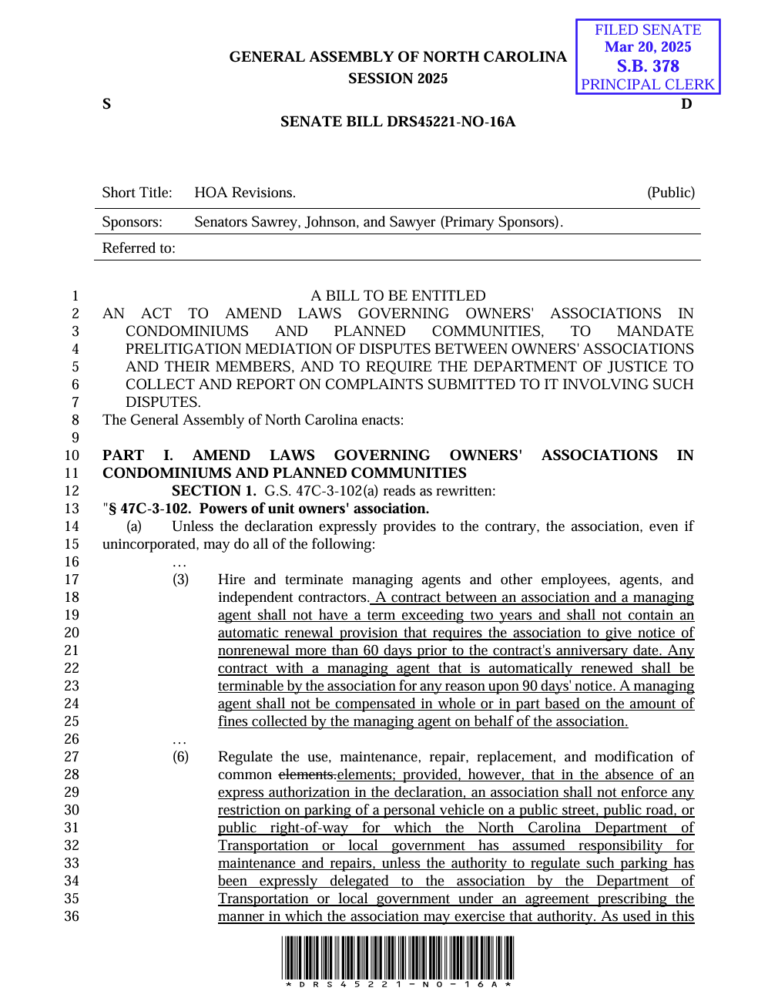
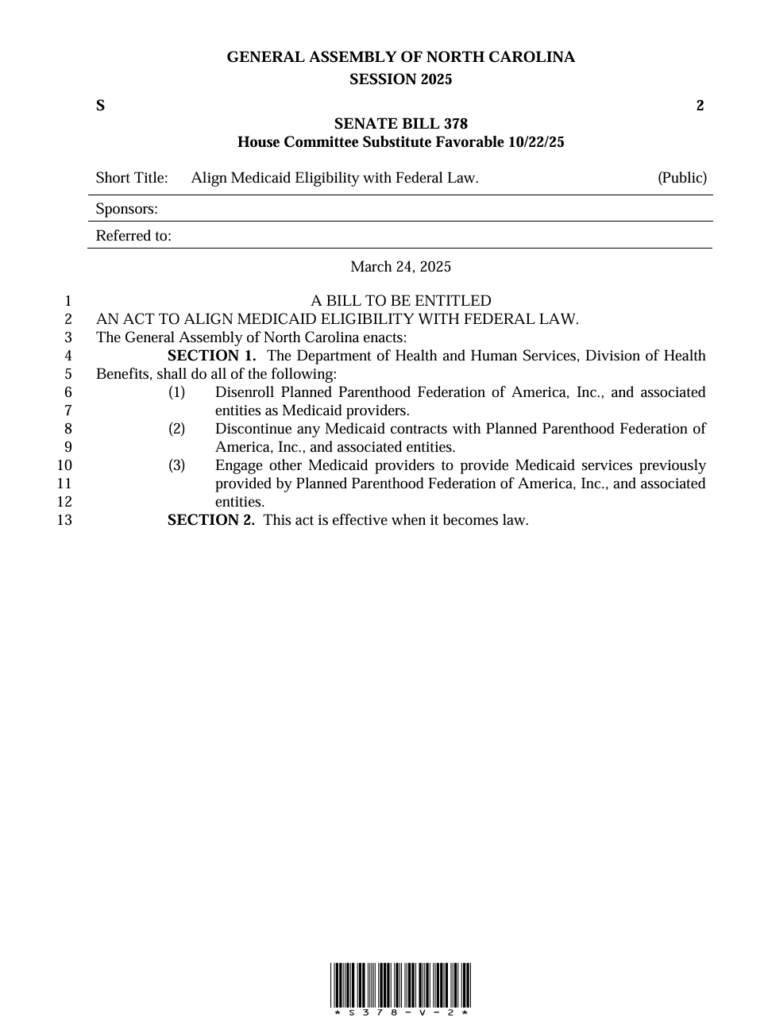
The version of SB 378 that passed the North Carolina Senate unanimously was later replaced with a House Committee Substitute. Compare the official legislative documents and review how the bill changed during the legislative process.

ORIGINAL SB 378

Passed the North Carolina Senate 47–0

The Senate-passed version proposed broad reforms to North Carolina’s HOA laws, including changes affecting fines, liens, dispute resolution, access to records, parking regulation, architectural review procedures, and homeowner protections

HOUSE COMMITTEE SUBSTITUTE

Judiciary Committee Substitute

The House committee adopted a substitute that revised the legislation before further consideration. The substitute modified several provisions of the Senate-passed bill and became the version debated in committee.

Scroll to Top